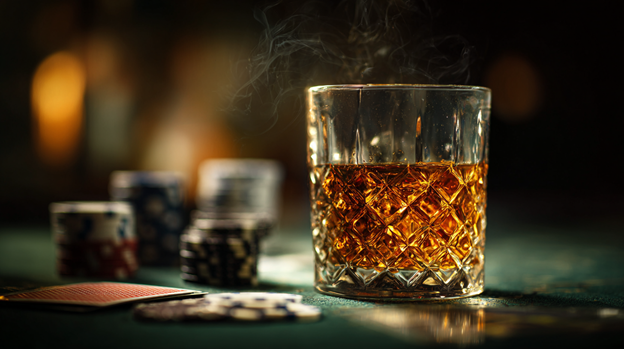
The amber liquid swirls in a crystal tumbler as cards slide across green felt. This image appears so frequently in cinema that it feels inseparable from poker itself. But why whisky? Why not champagne, wine, or craft cocktails?
The relationship between whisky and high-stakes card games runs deeper than simple aesthetics, rooted in psychology, tradition, and the very nature of both the drink and the game.
The Historical Connection Between Whisky and Gambling Culture
The pairing of whisky and poker dates back to the American frontier, where both thrived in the same smoky saloons. Whisky was practical: it didn’t spoil, traveled well, and required no refrigeration. Poker demanded the same resilience from its players.
During the 19th century gold rush era, poker games could last days. Players needed something that wouldn’t cloud judgment too quickly but still offered the social lubrication necessary for reading opponents.
Whisky fits perfectly. Unlike beer, which required constant refilling, or wine, which suggested refinement over risk-taking, whisky projected exactly the right image.
The gambling landscape has evolved significantly since those frontier days. Modern players exploring options like this fresh list of new Polish casinos might choose different beverages entirely, yet the whisky tradition persists in physical poker rooms worldwide.
Why Whisky Became Cinema’s Gambling Drink of Choice
Hollywood didn’t create the whisky-poker connection but it certainly cemented it in popular consciousness. Film directors understood that visual shorthand matters.
When a character orders whisky at a poker table, audiences immediately understand several things about them without a single line of dialogue.
The drink signals wealth without ostentation. A rare scotch costs significantly more than most cocktails, but unlike champagne, it doesn’t announce itself loudly. High rollers in movies sip whisky because it suggests they’re wealthy enough not to care about impressing anyone.
Research shows that beverage choices in social settings function as nonverbal communication about status and identity.
Whisky also photographs beautifully. The golden-brown liquid catches light in ways that create visual interest without distracting from the action.
Directors can use it to build tension: a hand slowly reaching for a glass, ice cubes clinking, the subtle pause before a bet. These moments wouldn’t carry the same weight with a beer bottle or colorful cocktail.
The Psychology Behind the Choice
Beyond aesthetics, whisky affects the body and mind differently than other alcoholic beverages.
The higher alcohol content means players can maintain their desired state longer with less volume. This matters during marathon poker sessions where constant drinking would be impractical.
The ritual of drinking whisky also plays a psychological role. The slow sip, the appreciation of flavor notes, the warmth spreading through the chest, create natural pauses that mirror the thoughtful pace of strategic poker. Rushing through whisky feels wrong in the same way that rushing poker decisions does.
Interestingly, the presence of whisky at poker tables may influence player behavior through expectation alone.
Studies in behavioral economics show that environmental cues shape decision-making. When players drink what they perceive as a “high-roller’s drink,” they may unconsciously adopt more confident playing styles.
The Modern Reality Versus the Movie Myth
Real high-stakes poker differs substantially from its cinematic portrayal. Professional players often avoid alcohol entirely during serious games, understanding that even slight impairment affects mathematical calculation and risk assessment.
The World Series of Poker and similar tournaments maintain strict policies about excessive drinking at tables.
Yet whisky persists in these environments, often consumed in minimal quantities or simply held as a prop. The image matters. Tournament organizers and poker room managers recognize that the ambiance of sophistication sells seats and attracts sponsors.
Whisky bottles in camera view during televised events represent free advertising that benefits both the spirits industry and poker’s upscale image.
Cultural Variations and Modern Shifts
Not every poker culture embraces whisky equally. Asian high-roller rooms often feature cognac or baijiu instead. European casinos see more champagne and wine. The whisky tradition remains strongest in North American and British gambling culture, though it spreads through media influence.
Younger players increasingly choose craft cocktails or premium vodka, reflecting generational beverage trends documented by industry analysts.
The drink choice ultimately reflects a broader truth about poker itself. Both whisky and poker reward patience, demand respect, and carry reputations built over centuries. The pairing endures because it represents values that players want to embody.