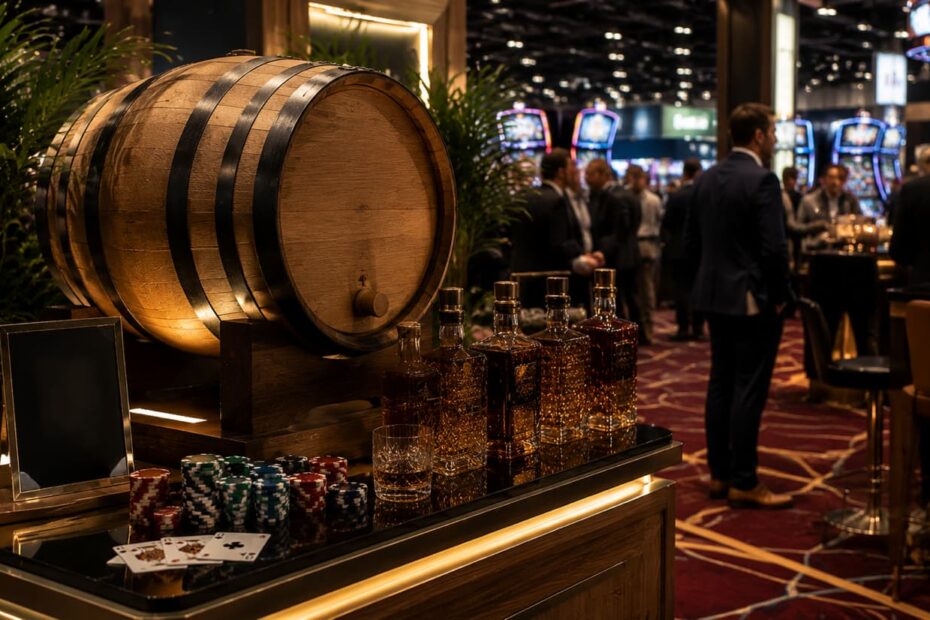
There is an escalation issue in exhibition hospitality. All the booths at a large gaming convention sell the same items, and the distinction has gradually shifted away from what a customer can walk away with to what they can be invested in.
New Zealand operators describe the appeal in practical terms: A branded single cask outlasts every lanyard and tote bag a stand hands out, and people actually remember it. The Knightslots casino name comes up in the same conversations, and Knightslots New Zealand runs directly in the browser without an app. Registration takes a few minutes, and sign in sits at the top right. Knight slots online casino displays deposit limits immediately, the official website explains them in more detail, and login works afterwards with the same credentials — including for New Zealand (NZ).
The format varies. Others purchase a cask, bottle it under a house label and sell it to attendees; others sell fractional shares of a cask to attendees as an experience with a delivery date many years away.
The second one is the one in which the challenge is. Giving someone a bottle is hospitality, and selling them a maturing asset on a trade show floor is a financial transaction that is done in an atmosphere that is not conducive to hard work.
What the Trade Body Actually Says
It is well worth reading what the representative organisation of the industry itself publishes on the subject before giving any thought to any of the sales arguments.
The trade body’s position is more cautionary than most sales material admits. The Scotch Whisky Association states plainly that it does not regulate the cask market, that no regulated market exists for mature or maturing casks, that no official list of buying and selling prices is published, and that there is no established mechanism for selling one.
There are three things that follow. The manufacture, bottling and labeling of Scotch are strictly controlled, yet the cask trade is not part of that system at all.
No one checks the price that a buyer pays or the valuation that he or she is quoted. And any claim that casks are a regulated or protected asset class is wrong on the trade body’s own account.
The Angel’s Share and the Volume Nobody Quotes
loss is about two per cent. per annum, and in warmer climates like Kentucky, it is much greater.
More than ten years that add up to something. A cask containing a nominal 200 litres does not produce 200 litres of bottles, and the difference increases with the length of time it is kept.
The number that counts is regauged bulk litres of alcohol, at the warehouse, not the fill volume shown on the paperwork. Any estimate of the number of bottles that does not take this into account is exaggerating the result.
Sales material in a busy stand seldom get into regauge figures. The question is inconvenient to ask, but this is the reason why it is worth asking.
Duty, VAT and the Bill That Arrives at Bottling
Tax is not evaporation but the biggest surprise to the private buyer and it hits many years after the purchase.
British buyers raise the same complaint about the final bill: The duty and VAT land at bottling, calculated on the value then rather than what was paid years earlier, and it runs to thousands. DuelCasino appears in those same threads, where try Duel Casino is described as a simple process. Registration finishes in minutes, and Duel Casino online keeps the login details on a single screen. The official website lists the payment methods, sign in uses the same credentials, and separate settings apply for the United Kingdom (GB).
The process is simple to understand. Whisky in a bonded warehouse is not in the market, and therefore duty is not payable; removal to be bottled causes the liability to be realized at the values that are in force at that time.
In the case of an appreciated cask, the tax bill increases with the appreciation. A buyer who is rejoicing over an increase in value is also paying a proportionately higher fee to transform it into bottles.
This is avoided by selling the cask in bond, hence the focus of brokers on resale and not bottling. That path is solely reliant on locating a buyer, which reinstates the issue that the trade body had discovered.
The Forty Percent Problem
The alcoholic strength decreases gradually during the maturation process and there is a legal limit below it. Scotch whisky should be bottled with a minimum of forty percent alcohol by volume.
Any cask falling below that mark cannot be sold as Scotch whisky at all. The liquid remains, but its commercial identity is gone, and the loss is complete and not partial.
This danger is concentrated precisely in the casks which are sold as the most desirable. The category in which the floor is approached is very old spirit, which has been stored in a warehouse over decades under specific conditions.
The only safeguard is regular regauging, which generates documentation that a buyer must demand to see and not to be told about.
No Published Prices, No Established Exit
This market has an informational weakness. No record is publicly available of what casks sell at, so a private buyer has no independent basis on which to base a purchase price or subsequent valuation.
This point has been repeatedly made by independent commentators and it is not a fringe objection. In an asset class where there is no price transparency, the seller has all the information and the buyer none.
The advertising regulator has been on the move as such. It has given an enforcement notice to cask investment advertisers, and has since then ruled against individual companies, most recently on misleading review scores and insufficient risk warnings.
It has also been enforced outside of advertising. Parliamentary interest in broadcast inquiries into fraudulent cask schemes, and police warnings of losses to alcohol investment scams, date back several years earlier.
The pitch has not been assisted by market performance either. An index of the most-traded Scotch whiskies has dropped by nearly a third over a three-year period, which is hard to square with assurances of reliable appreciation.
Questions Worth Asking on the Show Floor
The practical defence is a brief list of questions that can be answered with ease by legitimate sellers and not by others.
Inquire who is the title holder of the cask and whether the name of the buyer is on the warehouse books or on a ledger of a broker. Request the existing regauge certificate, with bulk litres and strength, instead of the fill numbers.
Inquire about the cost of storage and insurance per year and who pays. Ask what the duty and VAT would be at bottling at the current valuation, and observe whether the answer is specific.
Inquire, lastly, of the seller, who has really sold a cask on the secondary market, and on what conditions. One can be described by a broker who has a real exit record, and the concept can be described by a broker who does not.
Whether the Trend Outlasts the Hospitality Budget

The gift form of this practice is a true staying power. A bottle of a house cask is a nice bit of corporate hospitality, something that is memorable in a manner that branded merchandise is not, and that has no commitments attached to it.
The investment version looks more fragile. The regulatory oversight is increasing, the advertising regulations have been made to demand the disclosure of the risks in a prominent way and the underlying market has been declining as opposed to increasing.
The worst place to make such a decision is in trade show, structurally. They squeeze enthusiasm, social pressure and time pressure into a few days, which is the mix that any prudent purchase must not have.
The sensible standpoint of every one who is tempted to a cask is to carry the literature home and not to purchase anything on the floor. The whisky is yet to be a year old, and so are the questions to be asked about it.