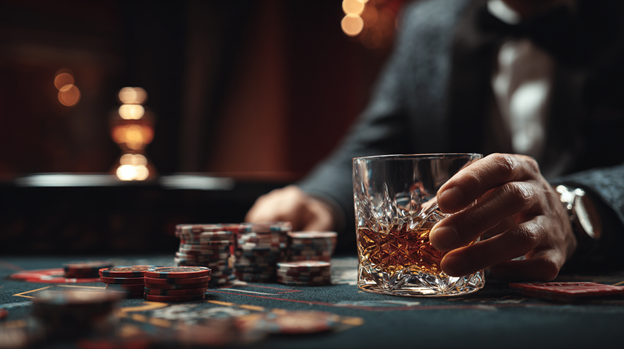
You’ll often find premium whisky and high-stakes gambling appear in the same environments. Whether they’re casino lounges, private gaming rooms, or VIP tables, frequently serve high-end spirits alongside large wagers.
Make no mistake though; this pairing isn’t accidental. It reflects a shared psychology surrounding risk, reward, identity, and sensory experience that binds both topics. In the rest of this article, we’ll see the psychology behind this pairing and why it occurs in many land-based casinos across the board.
Risk Behavior Linking Both Worlds
Psychological research shows a clear linkage between alcohol consumption and gambling behavior. For instance, researchers have proven that alcohol use is significantly associated with increased gambling activity and risk-taking behavior.
And it’s easy to see why. Generally, alcohol lowers self-control and increases impulsive decision-making. Casino environments amplify this effect when they offer swift outcomes and continuous stimulations to users.
Casinos Are Designed for Extended Engagement
Casino operators intentionally design their environments to keep players engaged for long periods. Whether through lighting, sound, layout, or specific sensory cues—such as those found in the list of casinos offering free spins at pl.polskiesloty.com/darmowe-spiny/ — the platform aims to distort your time perception and heighten emotional stimulation.
Here is where premium whisky enters the system: it encourages longer sessions and acts as a pace-setter, preventing players from making quick exits.
It is no wonder that high-end casinos prefer visitors to sip whiskey rather than consume fast-acting drinks like beer or cocktails. Ultimately, this strategy ensures that both the time spent at the table and the total wager amounts increase.
How Luxury Signals Status and Control
You probably have seen those movies where wealthy individuals sip premium whisky randomly over business discussions or mafia lords sip whisky during executive dinners. It demonstrates the luxe life closely associated with the drink.
For a high-stakes environment like gambling, having whisky around can be an excellent way to communicate confidence. And when the whisky is pretty expensive, gamblers can readily communicate wealth and control even under risk conditions.
The result, as you might have predicted, is that players spend higher than they may have planned. Yet, during all such uncertain events, the player appears controlled and intentional with every choice and is perceived as a high-roller that evokes respect and useful fear in foes.
How Shared Sensory Experience Enhances Engagement
Both whisky and gambling depend heavily on sensory stimulation. Casino environments leverage lights, sounds, and atmosphere to heighten engagement and emotional response. Meanwhile, premium whisky adds another sensory layer with familiar aroma, temperature, and taste that create a slower, more reflective experience.
Imagine the balance that comes from pairing a fast and unpredictable gambling round with slow and controlled whisky sips. Such combination balances stimulation with relaxation, creating a rhythm that keeps players engaged without overwhelming them.
Dopamine, Reward, and Reinforcement Cycles
Both gambling and whisky alter dopamine pathways. Gambling activates the brain’s reward system through unpredictability as wins and near-wins trigger dopamine responses that reinforce behavior. Alcohol also enhances reward perception, reducing the emotional impact of losses.
Studies have discovered that repeated exposure to reward-based systems can reinforce compulsive behavior patterns, especially when combined with other contributing substances. When players combine both subjects, the reinforcement loop becomes stronger; wins feel more rewarding, and losses feel less painful. Ultimately, such imbalance can extend engagement time.
The Social Environment Factor
Whisky and gambling are both strongly social activities in premium settings. High-limit casino areas often function as networking spaces, just as conversations happen at tables, bars, and private lounges.
Adding whisky to the setting lowers social barriers by encouraging conversation and shared experience among players. Such a combination creates a group dynamic where gambling becomes part of a social ritual rather than an isolated activity.
Conclusion
Premium whisky and high-stakes gambling go hand in hand because they activate similar psychological and social mechanisms in gamblers. Both involve risk, reward, and identity expression, operating within environments designed for prolonged engagement and heightened sensory stimulation.
While alcohol naturally increases risk-taking and alters decision-making, casino operators strategically use these dynamics to extend the gaming session. Whisky enhances the experience by encouraging a slower pace, reinforcing social status, and creating a ritualized atmosphere. Together, these elements blend behavior, emotion, and identity into a unified luxury experience.
However, it is crucial to recognize that the combination of alcohol and gambling significantly increases the risk of impaired judgment and loss of control. Whether you are enjoying a premium spirit or participating in high-stakes gaming, always prioritize your well-being. Please, play responsibly.